Category

Video Production

Union Jack Club Projection

Projection and Live Streaming

By Blog, Blog Post, Video, Video Production

Overview 

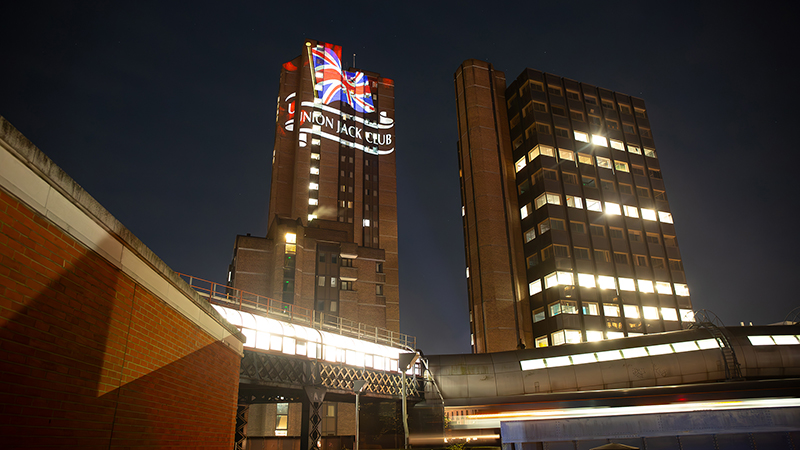
The Union Jack Club approached us to assist with the live streaming of a projection mapping project on the exterior of their building for Remembrance Day 11/11/23. The live stream needed to be directed to the UJC’s website only. This project required an extended specialist team to achieve this objective.

Watch 

Production 

Because the live-streaming was to take place from two locations, this meant that specialist mixing technologies were required.  

The UJC secured the location for the projection mapping, to be carried out by Motion Mapping from a nearby building Auberge on Sandell Street.  We then needed to locate two separate live-streaming locations.  This was a challenge due to other buildings affecting the visibility of the UJC even though the building is high with the projection featuring from the upper third.  Using an app, Planit Pro, allowed us to map out possible locations. Once these had been identified it was then for the team at the UJC to reach out to the facilities teams at those particular sites to enable access.

The nearby location for live-streaming was 1901 Arts Club, Exton Street and the furthest location was Centre Point, Tottenham Court Road, from a high vantage point.  Once locations were secured, it was for our live-streaming team Starlight Productions to recce the locations.  Together with inspecting technical aspects and carrying out risk assessments before signing this aspect of the project off.  There was no opportunity to carry out a trial run!

On the day of filming, the team were set up at the three locations: 1901 Arts Club, Centre Point, Auberge and inside the UJC in plenty of time for the live-stream to start at 6pm.  The projection mapping company had a holding graphic on the building and prepared itself for a 10-minute countdown.  A team member was set up with a laptop inside the UJC where the live-stream was mixed within the cloud.  In addition, sound was added for the online streaming to the website. The Military Wives Choir permitted the UJC to use their soundtrack, Remember.

Additional stills were captured of the various graphics on the building for archive and future use. 

Outcome 

The decision to live-stream to the website was to drive traffic over the weekend and the following month which was a strategic marketing decision allowing the valuable capture of data.  In addition, content was shared in advance to promote the live-streaming via e-newsletters and on social media. The live-stream was viewed worldwide from military bases and vetrans the world over.

Union Jack Club, Projection

Union Jack Club, Projection

Remembrance Projection
Remembrance Projection
Timelapse Video, Kao

Timelapse – 18th months

By Case Study, Timelapse, Video Production

At the beginning of 2022, we were approached by one of our clients Spa Comms to carry out a Timelapse video.  We’ve carried out plenty of Timelapse over the years and approached this one with the same enthusiasm as those that had come previously.  The brief arrived and this one was a little different.  They wanted to film for a year a whole building construction which was a first for our team.  The challenge was to find cameras that could be continuously powered outdoors with the ability to transfer data, without having to access the cameras themselves.

We began our research and identified that several options could provide solutions, the camera we decided upon was the Tikee by Enlaps.  This make of camera ticked all the boxes for us.  It allowed us to install two cameras on poles for the full duration and not touch them again until the project was finished.  It also allowed us to monitor the project remotely and keep a regular eye on the progress of the build, allowing our client to access imagery and footage, and share the status of the build. The software also enabled us to switch off remote filming at weekends and during the night. Another benefit of this camera is that a solar panel is attached to the top which keeps the cameras working throughout the project. 

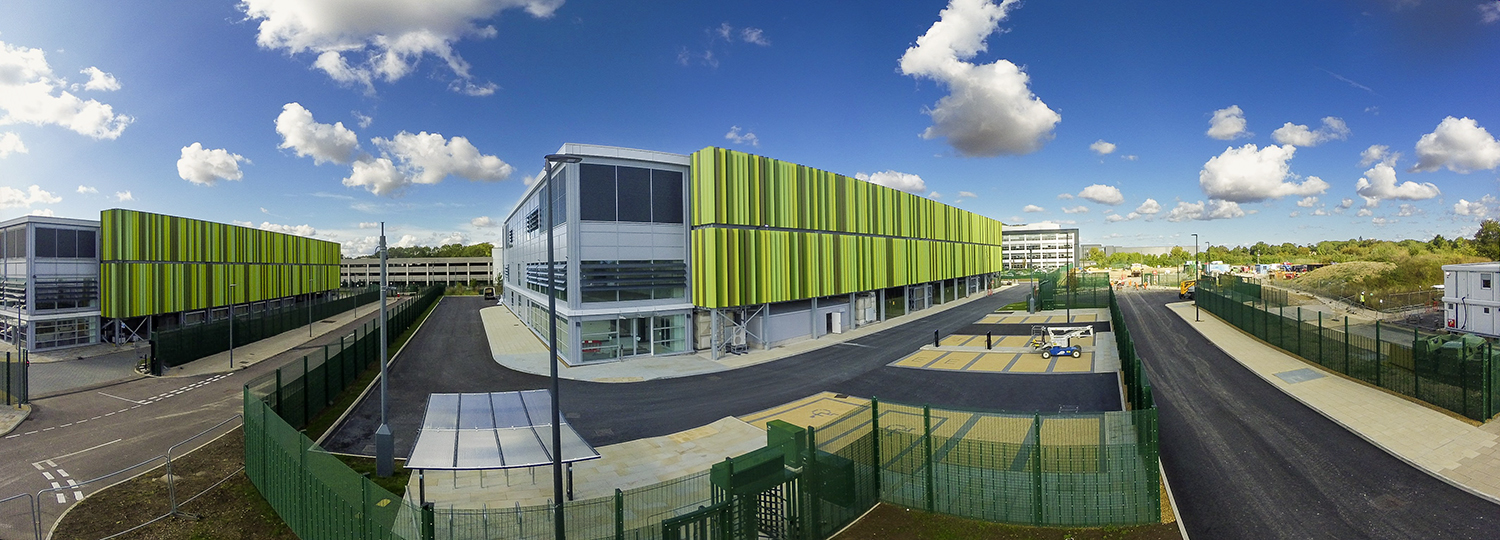
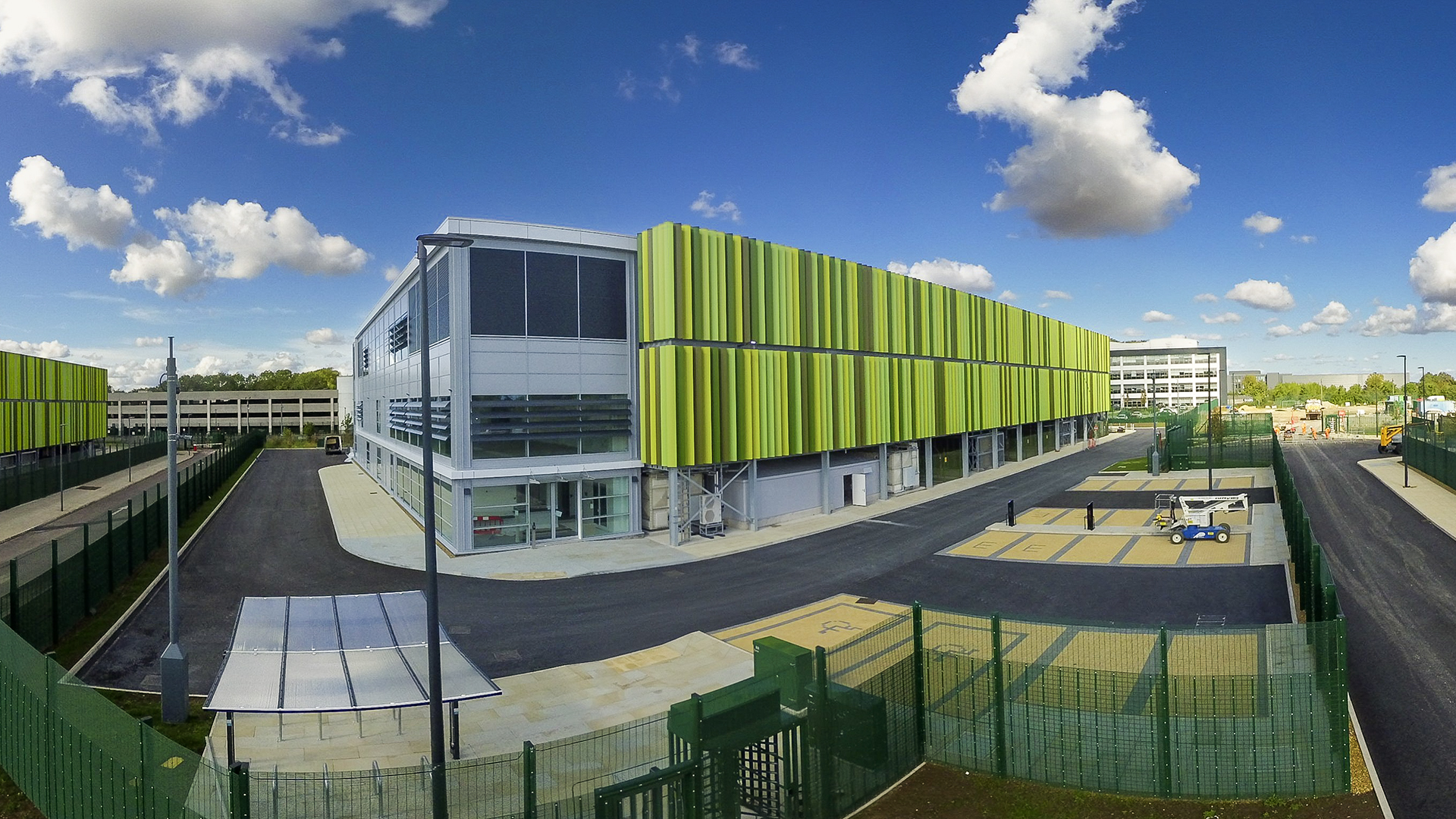
Timelapse Video, Kao Data Centre

Timelapse Video, Kao Data Centre

To achieve the connectivity we had to sign up to a 4G provider. From a little research, we discovered that Vodafone was going to achieve the strongest continuous signal which proved reliable throughout the entire project. It allowed data transfer from the cameras to be securely stored on servers.  The other benefit of the Tikee cameras was that they were robust which meant that the cameras continued to work through all weather including storm-force winds, extreme cold and heavy snow.  Another key feature was that the camera has a 220-degree angle of vision which meant for more creative editing.

The build was completed 18 months later by which time the timelapse project generated 40,000 images.  It was time to stitch them together and this is when the software came into its own.  We were able to specify the length of the video and programme the elements we didn’t want to use such as nighttime shots.  We could also programme the smoothness of the transition between the images.  Once completed, a short wait and the magic of Timelapse was ready for us to share with our client.  The flexibility of these cameras made for a successful project together with reliable 4G and software. 

Watch Here 

Extending the way video can be used within B2B settings

By Blog, Blog Post, Video Production

Video working two ways, promotional and internal communications

Thinking beyond the obvious way business uses video in the form of promotional, instructional, case study etc can be a crucial strategic move.  Video can be used in a less tangible way through the use of emotion, reaching employees, clients, prospects and as a recruitment driver, which can be achieved creatively. 

Page & Page & Partners, a London healthcare agency wanted to do just that, driving internal communications yet simultaneously to engage with existing clients, as well as prospects. Their aim was to communicate their process, culture and how creativity is at their very core when it comes to facilitating healthcare company’s global communications.  

This is a highlights video of their “Sofa Sessions” series. As well as a subtle promotional tool it also works as a retention mechanism in terms of its employees.  It promotes how their employees are valued as individuals and as a collective promoting well-being and  providing a voice for their individual thoughts and opinions.

Video Purpose

The video series was to be added to their Media Lab (hosted on Youtube) and to PM Live T40 

How 

Limewood Productions spent 4 days on location at The Ministry in Borough, filming the team, working  in small conversational groups on the sofa! A very loose script was provided to the creatives with various topics to chat about. These were to become the “Sofa Sessions”.  We then carried out the edits from the footage and they told their story through 7 episodes:

The 1st Page  – Why we’re here 

The 2nd Page – Progression

The 3rd Page – What inspires us

The 4th Page – Our creativity

The 5th Page – Our culture 

The 6th Page – The power of communication 

The 7th Page – The 4D’s that drive our process 

Crew & Equipment

A crew of 4 using 3 cameras: 

Camera 1 wide shot 

Camera 2 on 2 people

Camera 3 tight on person

X 2 LED light panels 

Gimbal,  generated speed and movement for the intros.

The Edit 

Working with their creative team we agreed on a style which could be applied to all episodes. We then selected upbeat music and fast intros for each episode.  We created a template that creatively allowed us to use text to convey messages and information. We used the full Adobe suite of software to work our magic.

Outcome

In addition to galvanising the team it allowed freedom of thought within the agency during the making of the “Sofa Sessions”. 

The “Sofa Sessions” series is a Finalist, PM Society Awards and has been shortlisted in the ‘Agency Internal communication and self-promotion’ category for an award.

Industrial Uniform Laundry Process

By Blog, Blog Post, Case Study, Uncategorized, Video Production

Objective 

To capture through filming CLEAN Linen’s ISO 9001 Quality Management Certified Laundry Process and to create video content for a range of platforms, communicating to customers and prospects. In addition to taking stills photography to support the project across different platforms. 

Process 

The client delivered a detailed brief and script that we interpreted visually for filming.

A crew of three people was required.  Two camera operators used Canon C300 Mk2 and a photographer used a Sony A9 to capture the stills. 

We used a range of equipment including a slider and gimbal. Due to the ISO specification, the crew had also to wear barrier clothing which made the physical work more challenging.

The majority was filmed on location at the Cheltenham laundry.  We spent a couple of days at this location filming the following process to tell the story. 

  • Uniforms are returned to the laundry, they are scanned and registered and sorted for damage and any foreign objects are removed. 
  • The washing process whereby full thermal disinfectant is used where dirt, bacteria and viruses are removed.
  • The laundry is then transferred to CLEAN Linen’s high care facility where a second scan and quality check are carried out, and drying and further thermal disinfection are used. 
  • Any reported damage is then investigated and repaired or garments are replaced. 
  • The garments enter the automated sorting process and then become ready for packaging to their individual requirements such as colour, size, departments etc. 
  • Garments are folded, packed and dispatched.  

Editing 

  • As this project was shot in 4K we collated a large amount of date which was stored on its own dedicated hard drives.
  • Proxy files were used to make for swift and smooth editing.
  • Editing out the interesting elements that followed the script. 
  • Text, is always challenging, to ensure that there is just the right amount of text to not distract from the content. Also ensuring the colour and tone works with the video and don’t become lost.
  • Grading is the icing on the cake. 


To tele-prompt or not to tele-prompt, that is the question?

By Blog Post, Technology, Video, Video Production

Many of our video projects involve people talking to camera in the form of interviews, quite often for case studies or promotional video content. This requires certain production to ensure that slick video is created.


Teleprompter

Reducing re-takes

Remembering lines can be tricky, some people find it easier than others, after all, they are not actors!  Like with everything today people have to flex with the times. We decided to invest in a teleprompter, thinking that this would resolve the issues as opposed to multiple re-takes.  Re-takes consequently take longer, feels and is less efficient and ultimately less professional.

Like everything, it’s a learning curve. The first couple of times the interviewee/presenter would stare at the screen and read the script.  The problem arose that after examining the recording it did appear as though they were reading their script, which is not the desired outcome.  The objective is for the person to come across natural, relaxed and as though they’re talking off the cuff about their subject.   We have arrived at some ‘best practice’, to help us produce improved video content.


Using the teleprompter

Best Practice

First up – script awareness

In many respects, the most obvious is for the subject to be aware of the script and to become familiar with their lines before the filming day.  You may ask, why is there a need to do this when the text is sitting on the teleprompter?  The teleprompter becomes a support and prevents people from going off message.  Additionally, not having a script people start thinking too much about what they are saying, which will often result in people hesitating and stumbling over their words.

Second up – the setup

How do we set up the teleprompter, or rather how do we embed the text on the page? We achieve this through uploading the text onto an iPad using data video software.  The trick is to keep the text large enough in order that it can be easily read and the eyes don’t have to scan across the page to read the words; this reduces obvious eye movement.  Also, breaking the sentences up into blocks of text, leaving space between them also helps. People are more likely to pause at this point rather than rushing through their sentences.

Controlling the speed of the text is also essential.  If it’s too fast, people concentrate on the text and easily slip into reading mode.  If it’s too slow we get the same result. So practising to establish the right speed in the first instance is an important stage and that the reader is comfortable.  This means checking a practice recording and this will be different for each person.

Third up – distance from the subject

Finally, the distance the subject is from the camera is crucial. If the subject is sat too close, then it becomes more obvious that they’re reading from a teleprompter, as their eyes can be seen scanning across the screen, so a little further away can help. Again experiment until you’ve achieved the correct distance.

To sum up, to optimise your filming using a teleprompter: make sure the script is learnt, space between the text, practice the speed and finally don’t have the teleprompter too close to your subject.

The teleprompter we use is a: Datavideo TP300 and an iPad with data video software.

Video Case Studies

By Blog, Blog Post, Case Study, Uncategorized, Video Production

What are video case studies?

We hear about the power of storytelling and how this can be used as a tool for persuasion to engage.  When used well and enhanced using video, they can help generate conversions. A story-based structure are typically used for video case studies and are filmed on location and involve interviews with key people within the business.

The London Patient case study video focuses on how Hospitality Action help their people.  It also acts as a fundraiser.  this case study is also about pioneering science that has helped only the 2nd person in the world to recover from both HIV and cancer through stem cell.

Why use video case studies?

A video case study can also help set you apart from your competition, demonstrating the value you can offer whether this is product or service based.  They play out how a common or specific problem can be overcome by using your product or service, providing the solution.

Education is key, the more information you provide your potential customer, the easier their buying decision becomes. They don’t require any of the sales talk or self-promoting publicity found in other marketing.

Video case studies though factual, are more personable and travel much deeper than reviews and testimonials and therefore can be mighty powerful. Their importance has real value as they can provide real and tangible solutions that are evidence based and therefore on-going trust is built.  And without any of the sales talk or self-promoting publicity found in other marketing too.

On balance video case studies provide a richness together with other elements of your marketing mix and when engaging with video can increase its magnitude.

Video case study process

Storyboarding – this is critical to have an outline of so that the production can be planned.  This would commonly involve liaising with the marketing team or PR. 

Opening slates – with branding, helps viewers easily relate to the subject of the case study.

Identifying the problem – Identifies the issue and challenges that your business can solve, commonly achieved through video interview.

The solution itself –  A  tangible explanation as to how your business can helped solve the solution including any challenges in achieving expected results.  Identify value that is added through that process. Video interview and the location/product.

Benefits of the solution – Ensure the benefits are clear and areas that perhaps need further exploration.  Honesty of the customer about the solution provided translated in a way that evokes integrity.

Results driven –  Metrics should tie back to some form of ROI, whether that’s time-saving, money-saving, revenue creation, customer retention.

Closing slates – Contact details, website or specific web page.

Delivery Delivered in formats required for your channels.

Case Study Videos 

Chapter One at Home – Case Study 

Schneider, Wellcome Sanger Institute Case Study

William Murray – Santa Maria Spices Case Study

Hospitality Action, Video of re-branding 

Gulf Business Machines Case Study

Banque du Liban, Lebanon Case Study

CLEAN Linen and Workwear 

These videos we have produced and have been used within client case studies

The buyer’s journey and where video case studies fit

Case studies have a specific place which is towards the end of the sales funnel. They feature near the end of the consideration and early in the decision stage of the buyer’s journey. When a customer is deciding between potential solutions, the information they glean from case studies can  heavily influence.

However, earlier in the buyer’s journey, the existence of case studies has its place. Customers want to know you’ve had customers using case studies successfully. The details of the solution might not be super important initially, but whether or not you’ve helped a similar company in a similar situation can determine whether someone continues to evaluate your company as a compatible business to work with. 

Case Studies help with entering new markets

One of the biggest challenges when entering a new market is the lack of recognition for your company. Being able to enter a market with some case studies already in existence can help you overcome that initial hurdle. It’s important to focus on closing high-fit customers who result in good case studies as your early customers. 

The Takeaway

The trust buyers place in businesses and their marketing and sales materials has been trending downwards. According to Hubspot,  ‘81% of people trust their friends and family’s advice over advice from a business.’ Case studies are a brilliant method for you to present an external viewpoint on your company while still retaining some control over the narrative. They are best storyboarded, working with the company marketing or PR team.

Even though you’re producing the video case study they are about the customer and not about your business.  Your website is about your business offering, but uniquely, video case studies are about your customer and not about you.

Useful, further reading about Case studies can be found at Hubspot

GET IN TOUCH
AND GET TO KNOW US
Your Information will never be shared with any third party.
Please enter your email address below to view our rate card
TO VIEW OUR RATE CARD
Please enter your email address below
  We hate spam and never share your details.